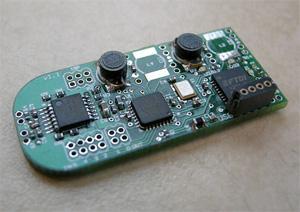
This board that I developed fits inside of each of the three fingers of Intel
Labs Seattle’s mobile robot. It includes two resonant transmitters for
generating high voltage AC signals, two analog front-ends for amplifying the
received current to be fed into the microcontroller’s ADC, and enough
processing in the microcontroller to perform synchronous demodulation on the
received signal.
E-field sensor board for robot fingers
Each transmit-receive pair has unique geometry and constitutes a unique
measurement. Within a single finger, four different transmit/receive channel
pairs are possible: with the current antenna configuration in the fingers,
there are split left and right receive electrodes and mid- and short-range
transmit electrodes. Each finger can also be linked to a third transmit
electrode in the palm of the hand, which provides additional left and right
long-range channels.
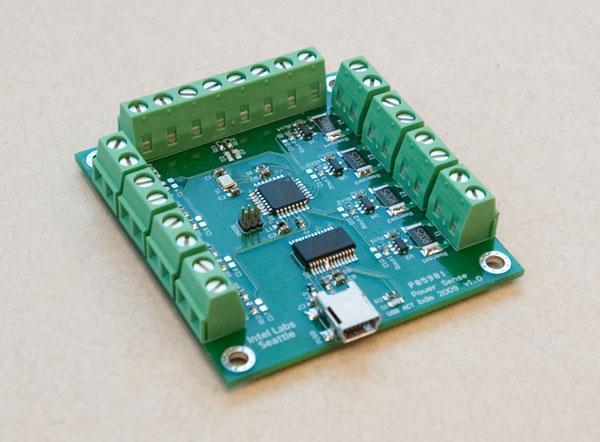
I designed this board to monitor the power system in Intel Labs Seattle’s
mobile robotics platform. It provides four current and four voltage
measurements, and interfaces with a PC via USB. Readings for all of the
channels can be read at over 100 Hz.
In the autumn of 2004, I moved to Seattle to attend the University of
Washington. I began taking photos to share some of the neat places I discovered
while exploring the areas around campus with my family and friends back at
home. I started with a pocket-sized point-and-shoot digital camera, back when
they were starting to become popular. As I learned more about the art and
science of photography, I’ve moved on to cameras and lenses that afford better
manual control.
I still enjoy taking walks around the beautiful University of Washington campus
on weekends and capturing some of the scenery.